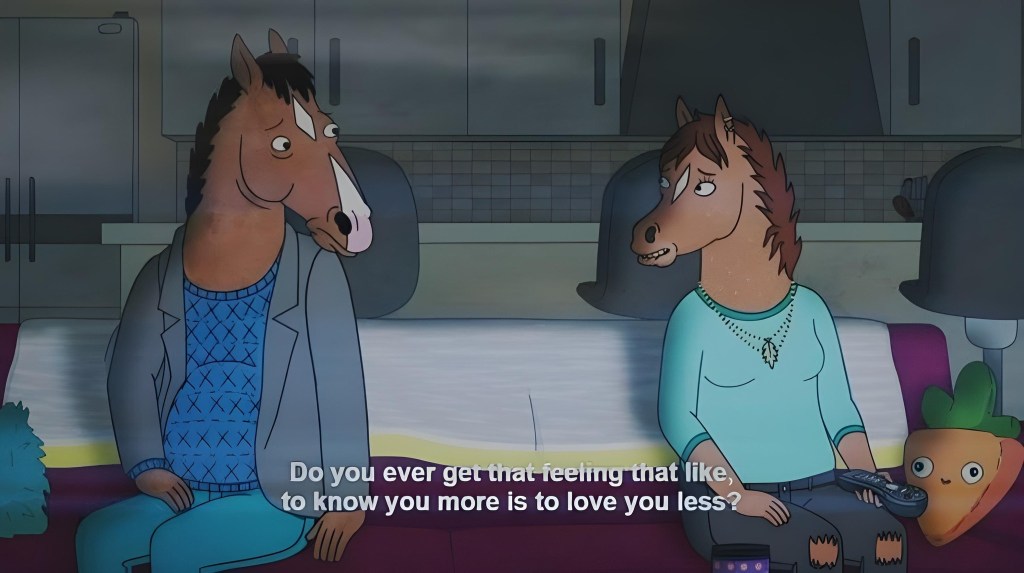
I tend to seek fewer, deeper relationships, and I do not apologize for naming them as deep as they actually are, even when they do not follow the traditional relationship escalator. By that, I mean the default script where “real” relationships are expected to move through a series of milestones (exclusive dating, cohabitation, marriage, kids, forever) and are judged by how far they climb that ladder. For me, the absence of those milestones does not make a connection any less serious.
When we met, I was their sixth partner. They remained my only outside partner for the first three years, and my only “serious” partner since meeting them until today. During that same period, their “body count” (their term) went from 6 to 29, and they were genuinely excited about hitting the “major milestone” of 30. My own number, in contrast, increased by 2. This is not about slut shaming; it is about highlighting how differently we each approached ENM and polyamory. Research on consensual non monogamy suggests there is a wide spectrum here: some people are more novelty oriented or breadth oriented, others are more oriented toward depth with fewer partners, and both can be valid if clearly and ethically negotiated. In our case, that mismatch became central to larger relational tensions.
I have stayed in touch with their soon to be ex husband, who chose to remain in Indiana rather than move to Colorado. From his perspective, the marriage eroded when his wife began setting increasingly strict boundaries with him while offering the emotional and sexual availability he longed for to other partners instead. In his words, it felt like the qualities he most needed in the marriage were being exported outward to everyone else.
From her perspective, things look very different. She describes going through intensive therapy and trauma work that led to a long stretch of asexuality. He was the one who initially suggested opening the marriage, which, as I understand it, was meant primarily to address unmet sexual needs. Over time, though, he seems to have fallen in love with an outside partner, perhaps just one or a small number, while she moved from seeking mostly sexual connections into a larger cluster of romantic and sexual relationships that were more turbulent and numerous.
Somewhere in that process, he felt functionally relegated to “roommate status,” while also being cast, at least in how the story was told, as the problem for wanting the kind of intimacy and attention that was being freely shared with others. My partner occasionally spoke of him in ways that raised flags for me: talking about feeling “suicidal” in the marriage, describing him as weak, and framing his needs as unreasonable. The dynamic echoed how my own wife once framed me during our transition from monogamy to polyamory. It felt familiar to be watching a story where the person asking for reciprocity inside the original relationship was gradually recast as the villain.
Her framing of his decision not to move to Colorado was especially striking. For her, his choice was experienced as a betrayal and a profound wound. From my vantage point, it looked more complicated: it seemed like that decision became the final narrative justification for letting go of the marriage under the banner of “boundaries.” Boundaries, in a clinical sense, are supposed to protect safety and clarify responsibility; they are not inherently about assigning moral blame. Yet the way it was described to me sometimes resembled what psychologists call DARVO, deny, attack, and reverse victim and offender, where the person being confronted about a hurt shifts the focus, casts themselves as the injured party, and positions the other as the primary wrongdoer.
I am not in a position to diagnose her behavior or to know the full reality inside that marriage. What it felt like, from the outside, was a subtle pattern of self protection that slid toward self justification: using the language of trauma and boundaries to support a story in which she was always the one being harmed, and anyone asking for more mutuality was, by definition, unreasonable or unsafe. Socially, that story seemed to get reinforced by new partners and friends who mostly heard her side and reflected it back, creating the kind of echo chamber that confirmation bias thrives on.
I also suspect this may be part of why she rarely wanted to talk in detail with me about the dynamics of her marriage. My own history placed me much closer to her husband’s role, I was the one left behind when a spouse expanded outward in the name of growth and authenticity. I am also the type of person who will name it when something does not add up. My presence, and my questions, might have threatened the coherence of the narrative that allowed her to move forward without looking too closely at the impact on the person she had once committed to.
From a psychological lens, what unfolded looks less like “polyamory went wrong” and more like a clash of attachment needs and relational scripts playing out inside an ENM structure. Research on attachment and consensual non monogamy shows that people bring very different comfort levels with intimacy, autonomy, and emotional availability into these arrangements, and those differences can become fault lines when they are not named and negotiated explicitly. In our little polycule, that mismatch, between my preference for fewer, deeply invested connections and her drive toward multiple rapidly forming, high intensity relationships, was not a moral failing on either side. It was a structural and psychological incompatibility that neither of us fully understood at the time.
Where this became personal was in how that same pattern eventually played out in my own relationship with her. We had formed our partnership after a casual dynamic with me and my nesting partner, with the explicit and mutual intent to go deeper individually. Over months, then years, I consistently expressed that hope: that we would build toward seeing each other more regularly, that I saw her as serious and significant, that I was making space in my life for that depth. She never corrected me. There were even moments when she encouraged the idea, once suggesting I move into her apartment complex, and to the point I had put a deposit on an apartment so we could be closer. So when I finally asked for clarification before moving out there a year later, her response felt like a rug pull.
What she told me, in a long and carefully worded message, was that she wanted what we had been doing, texting, occasional FaceTime, proximity without primary style emotional support. She said she did not see us as the kind of partners who move across the country for each other, that she was not interested in going deeper or being relied on more. She wrote that going from where we were to a standing weekly overnight in a year seemed like a really big ask. She clarified that what we had been doing was what she wanted and what worked for her.
The language itself was not cruel. But the frame was devastating. She was, during that same period, building deep, entwined, emotionally rich partnerships with others she had met less than a year before. She was giving them the very things I had been asking for and told were too much. The problem was not that she wanted something different for herself. The problem was that she had let me tell her, repeatedly and without intervention, how serious I saw us, how much I valued her, how I was shaping my life around the possibility of us over a long period of time. She had even, at one point, allowed me to set her as a beneficiary on my life insurance. To receive that message after years of investment felt like discovering the foundation was never what I had been told it was.
This was not a failure of polyamory. This was a failure of relational clarity over time. Research on attachment injuries shows that when one person builds expectations based on years of implicit permission and the other suddenly enforces a boundary that contradicts those expectations, the result is a profound sense of betrayal, even when no deception was intended. The brain registers it as a violation of the social contract that had been enacted through behavior, not just words. In my case, it felt like being reduced to less than a full human being, not because she owed me a certain relationship structure, but because she had accepted my full humanity, my depth, my hope, and then told me that depth was the problem.
It is possible her feelings changed over time. It is possible she did not know how to name her limits earlier. But the pattern remains: I was allowed to express seriousness and investment for years without correction, while she simultaneously built that level of seriousness with others. When I finally asked for what I had been told was possible, the boundary appeared, and the narrative shifted. I was asking for too much. I was pressuring her. I was the one who had misread the situation.
That is not a story about polyamory. That is a story about what happens when one person’s enacted values, who gets time, who gets depth, who gets priority, diverge from their stated values, and the other person is left to reconcile the gap alone. It is also, I think, why she stopped wanting to talk about her marriage with me. I had lived the role her husband lived. I would have pointed out the pattern. And that would have threatened the story she needed to tell herself to keep moving forward.
 Little Lifeboat
Leave a comment